












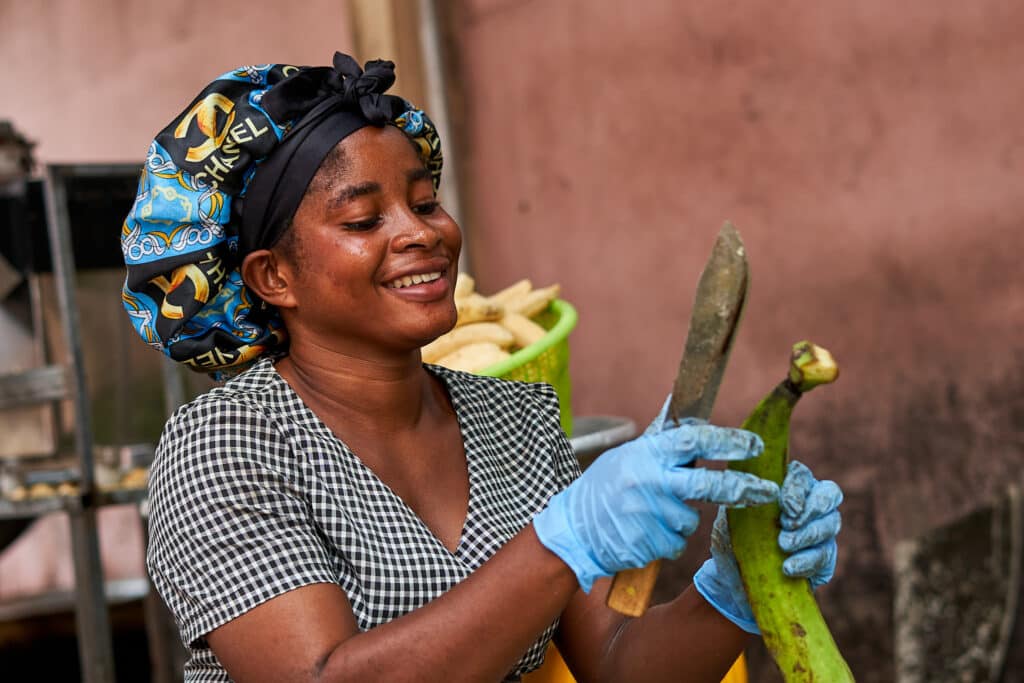
Shell Foundation and Startup Discovery School launch the West Africa Aggregator Service Platform to boost the incomes of women smallholder farmers

Accra / Dakar, 12 March 2026 — Shell Foundation (SF), an independent charity that empowers underserved customers to raise their incomes while lowering emissions, with support from the UK Foreign, Commonwealth & Development Office (FCDO), has partnered with Startup Discovery School (SDS), an innovation infrastructure partner delivering multi-year entrepreneurship and venture-building programmes focused on climate action, gender inclusion, and inclusive economic growth across Africa, Asia, and the UK. Together, they launched the West Africa Aggregator Service Platform (WAASP) to boost income growth for women smallholder farmers.
WAASP is a one-year pilot programme operating in Ghana and Senegal. The initiative will explore whether existing climate-smart agricultural solutions can have a practical and transformative impact on women smallholder farmers through redesigned delivery models.
It will test service-based, shared and layaway delivery models designed to reduce upfront costs, distribute risk and make proven agricultural technologies viable for women farmers. It targets at least a 20% increase in incomes while establishing scalable pathways to reach 200,000 farmers—at least half of them women—by 2030.
Redesigning proven climate-smart agricultural solutions to empower women farmers
In West Africa, women make up 40-60% of the agricultural workforce, yet most farm small plots with limited capital and high exposure to climate shocks. While yield-improving and post-harvest loss-reducing technologies are widely available, adoption among women farmers remains constrained due to barriers such as large-unit sales, requirements for equipment ownership, or reliance on formal credit.
To address this gap, SDS will coordinate structured six-month validation cycles to test delivery models through three established farmer networks: myAgro in Senegal, Vitara and Complete Farmer in Ghana. These networks collectively serve more than 500,000 smallholder farmers across the two countries, working in value chains with high women farmer participation.
The initial cohort of solution providers includes:
- Synnefa (smart solar drying technology) ;
- ColdHubs (solar-powered cold storage) ;
- Irri-Hub (solar irrigation systems).
Additional providers—offering low cost fertilizer and climate-smart poultry—have been selected for alignment with women farmers’ cashflow realities and scalable service-based deployment.
Each solution will be assessed against common performance criteria, including adoption, retention and measurable income effects. Models failing to demonstrate commercial viability or income improvement will be adapted or discontinued. Validated approaches will be integrated into aggregator operations to establish sustained distribution pathways rather than stand-alone pilots.
A replicable coordinated model for inclusive agricultural growth
By integrating validated solutions into these existing networks, WAASP aims to create a replicable coordination model that reduces market fragmentation, lowers scaling costs, and enables future expansion across West Africa—including into Nigeria.
Startup Discovery School (SDS) implements and coordinates the platform, overseeing solution sourcing, pilot design, and performance tracking across the farmer networks in Ghana and Senegal.
Shell Foundation and the UK FCDO serve as the anchor co-funders, with additional support provided by Autodesk Foundation and the Australian Centre for International Agricultural Research (ACIAR) through the Nurture Program, to enhance innovation design, technical validation and research rigor.
WAASP is structured as an open coordination platform, with additional farmer networks, solution providers and funding partners expected to be onboarded as evidence and scale pathways develop.
Jonathan Berman, CEO of the Shell Foundation, said:
WAASP is testing whether coordinated, service delivery can scale climate-smart agriculture with women at the center. This partnership brings major public and philanthropic funders — including Shell Foundation, the UK FCDO, Autodesk Foundation and ACIAR — alongside strong regional delivery partners, reaching over half a million farmers in Ghana and Senegal.
Mandy Nyarko, CEO of Startup Discovery School, said:
Many proven technologies fail to reach women farmers because delivery models are misaligned with their cashflow and risk profile. WAASP allows us to coordinate disciplined validation across networks and identify models that can scale sustainably.
Over the next year, WAASP will publish findings on adoption, income outcomes and delivery economics to inform expansion across the region.
About Shell Foundation
About Startup Discovery School
Latest news and updates
500 Global and Shell Foundation Release Market Report on Scaling Sustainable Cooling and Clean Cooking in Emerging Markets
17th September 2026