














If Food Is So Expensive, Why Aren’t Farmers Rich?
Goziem Okubor
Nigerians have spent the past few years experiencing the effects of rising food prices. The IMF estimates that 27m people faced food insecurity in late 2025. Yet many of the people producing that food remain poor. If consumers are paying so much, why isn’t more of that money reaching the farmer?
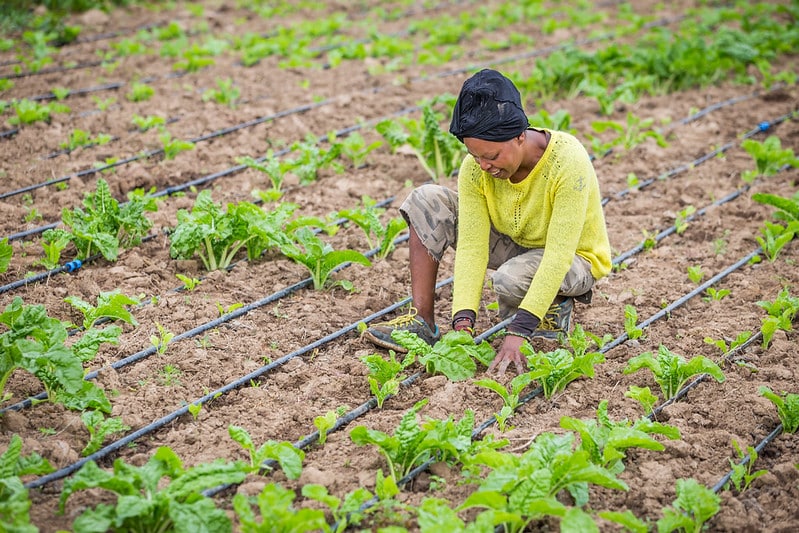
Working with rice farmers in northern Nigeria since 2023 has made me think differently about that question. Through Project Clean Green, a partnership between Shell Foundation and AFEX commodities, we set out to build solutions to what seemed like a fairly obvious problem. Many small farmers growing rice during the dry season rely on petrol-powered pumps to irrigate their fields. When Nigeria removed its petrol subsidy in 2023, irrigation became much more expensive. The project financed solar pumps, in addition to inputs like seed and fertilizer in a bundle that farmers could repay over several harvests. By June 2026, 1,504 pumps had been disbursed, giving 10,779 farmers access to solar irrigation.
In the development world, we tend to describe solar irrigation as a climate intervention. Foundations, development finance institutions and climate investors see cleaner energy, lower emissions and greater resilience. The farmer may see something more immediate: a way to stop buying so much petrol. He needs water on his field, and he needs to get it there cheaply enough to make farming worthwhile. If sunlight can pump that water more cheaply than petrol, the climate benefit comes with a better economic proposition rather than at the expense of one.
Early evidence was encouraging. Between the baseline and midline periods of our evaluation, the petrol price used in the analysis rose from ₦708 to ₦1,165 a litre. Yet average seasonal fuel spending among farmers surveyed at midline was about ₦136,000 lower than among the baseline group. High fuel costs, cited as a constraint on yields by 71% of farmers at baseline, were mentioned by only 7% at midline. Farmers said some of the money saved went instead to food, school fees and paying debts.
The farmers surveyed at midline were also doing better on the farm. Average rice yields among comparable groups were 11% higher, at 4.1 tonnes per hectare, and mean net income was about 12% higher. Because the baseline and midline surveys did not follow exactly the same farmers, those figures don’t prove that the pumps alone caused the increases. But together with the sharp fall in fuel use, they suggested that the economics of irrigation had improved.
Then the farmers’ problems changed. Fuel, once one of the biggest obstacles to producing more, had almost disappeared from the list. Fertiliser had become much more important. Seeds and fertiliser were now the farmers’ biggest expense, and the evaluation identified fertiliser use as an important remaining lever for raising yields and incomes. We had not solved the farmer’s problem. We had solved one problem and, in doing so, revealed the next.
Much of agricultural development is organised around individual solutions: irrigation, fertiliser, mechanisation, credit, market access. Institutions need categories like these to organise themselves. Farmers do not. A farmer is running a business under considerable uncertainty. Cheaper irrigation helps him grow the crop, but he still needs seed, fertiliser and labour. Once the crop is harvested, another question takes over: what can he sell it for?
Our evaluation raised questions here too. The income farmers reported appeared substantially lower than the value their harvests might have commanded at the reference market price used in the analysis. But the data did not tell us where, when or through whom every farmer sold. A price quoted at a commodity market is not necessarily available at the farmgate. Quality and location matter. Transport costs money. The evidence showed a gap, but it could not fully explain it.
That uncertainty led us to another question: what is a good market price worth to a farmer who cannot get it? He may know that his rice is worth more somewhere else, but moving it there costs money. He may expect the price to rise after harvest, but waiting requires storage and cash. School fees do not wait for the rice market. Neither do workers, lenders or household expenses. A buyer who can wait and a farmer who needs money today arrive at the same negotiation with very different choices.
Someone I respect once told me that at the most basic level, a farmer is a risk manager, and the more development work understands this, the better solutions will be. The longer I have worked around agriculture, the more useful I have found that idea. We often ask why a farmer is not maximising yield, holding his crop for a better price, borrowing to invest more or adopting a technology with apparently attractive returns. But those questions can assume that he is trying to maximise one outcome. In reality, he is managing several risks at once: the weather may turn, the harvest may disappoint, prices may fall, a buyer may not appear, or a loan may still need to be repaid.
A decision that looks suboptimal against the best possible return can therefore be rational against the possibility of a disastrous one. A warehouse may allow a farmer to wait for a better price, but only if he has enough cash to wait. Finance may make an asset affordable while leaving him exposed to the price of what he produces. A technology can offer an attractive expected return and still be unattractive if it introduces a risk his household cannot afford to bear. When assessing an intervention, then, we should ask not only what return it might create, but which risks it removes, which ones remain with the farmer and whether he can afford to carry them.
This is why the less glamorous parts of agriculture matter. Storage, transport, finance and aggregation help determine how much of the value created on a farm remains with the farmer. They also help explain how food can be expensive at one end of the chain while farming remains precarious at the other. The IMF estimates that transport accounts for roughly a quarter of the retail price of food in Nigeria. It also estimates that imported food accounts for about 30% of consumption, while domestic food prices are affected by fuel costs and climate shocks as well as international prices. Between the farmgate and the market stall sit transport, storage, processing, finance, spoilage and risk. The retail price of food is not the farmer’s income.
The next phase of the project made this point more starkly. Paddy prices fell from a 2024 high of ₦61,500 per bag to around ₦30,500 by November 2025. Some farmers produced more but saw their margins shrink; programme reporting from Kebbi found that many struggled to recover their production costs. Repaying financed equipment became harder. Apart from a changing food import policy, the causes of that price fall deserve separate analysis. What matters here is what it exposed. For consumers, cheaper rice can be welcome. For farmers, it can be brutal. Seed and fertiliser were bought months earlier, labour had already been paid, and a lower price at harvest does not make those costs disappear.
This is the paradox Project Clean Green helped make visible to me. The solar pumps worked. Fuel dependence fell sharply and farmers saved money; yields among the midline group were higher. Yet technical success could not guarantee that the farmer’s business would succeed, because irrigation was only one part of its economics.
Nigeria certainly needs more productive agriculture. Better seeds, irrigation, mechanisation and other technologies can help. But there is a dangerous “therefore” in the familiar argument that higher productivity will therefore make farmers richer. Sometimes it will. Sometimes another constraint will absorb part of the gain.
The lesson is not that every agricultural programme must solve everything at once. That would produce expensive, unwieldy programmes. It is that the binding constraint moves. Remove one obstacle and the next one matters more. That changes how I now look at agricultural investment. I increasingly ask three questions: What is stopping the farmer from making more money today? If we remove that constraint, what is likely to become the next one? And most importantly, who must eventually make money from solving it if the solution is to survive without subsidy?
Those questions can lead capital to very different places. If cheaper irrigation allows farmers to cultivate more land, fertiliser or finance may become more valuable. If higher yields create bigger harvests, storage and access to buyers may matter more. If a farmer can store his crop but cannot afford to wait for a better price, working capital may be the constraint. Another thousand pumps will not solve any of those problems.
The same reasoning changes how I think about Nigeria’s food-price problem. It is tempting to frame food policy as a contest between consumers who need lower prices and farmers who need higher ones. The harder and more useful question is how to make food cheaper without making farming unprofitable. That means looking for costs that can be taken out of the system rather than simply arguing over who should absorb them. Cheaper production, better storage, more efficient logistics and appropriate working capital can improve the economics on both sides of the transaction.
This is a more ambitious objective than simply raising yields. It asks us to judge an agricultural intervention not only by whether the technology works, but by whether the farmer’s economics eventually work. Governments, development banks, foundations and investors can spend millions proving the first and still fail to achieve the second.
Project Clean Green began with a fairly straightforward question: could solar irrigation reduce farmers’ costs and improve their incomes? The evidence on fuel use is encouraging. But working on the project has left me more interested in the question that follows: if this works, what happens next? Following that question takes us beyond the pump, to fertiliser, credit, warehouses, roads and buyers. More importantly, it keeps the farmer’s economics rather than our intervention at the centre of the analysis.
At the end of a season, after the harvest has been sold, the loan instalment paid and the household’s bills met, there is a simple test: ask the farmer whether he wants to plant again, and how much. His answer contains his assessment of the return he earned, the risks he carried and whether taking those risks again is worth it.
Nigeria’s future food supply depends, in part, on that answer.
Goziem Okubor is a Nigerian development economist and practitioner. He is Chief of Staff to the CEO and leads business development for smallholder agriculture and West Africa at Shell Foundation. His work focuses on the role of markets, capital and institutions in Africa’s economic development.
Latest news and updates

Turning shocks into tailwinds: unlocking commercial capital for climate solutions in emerging markets
15th July 2026