
















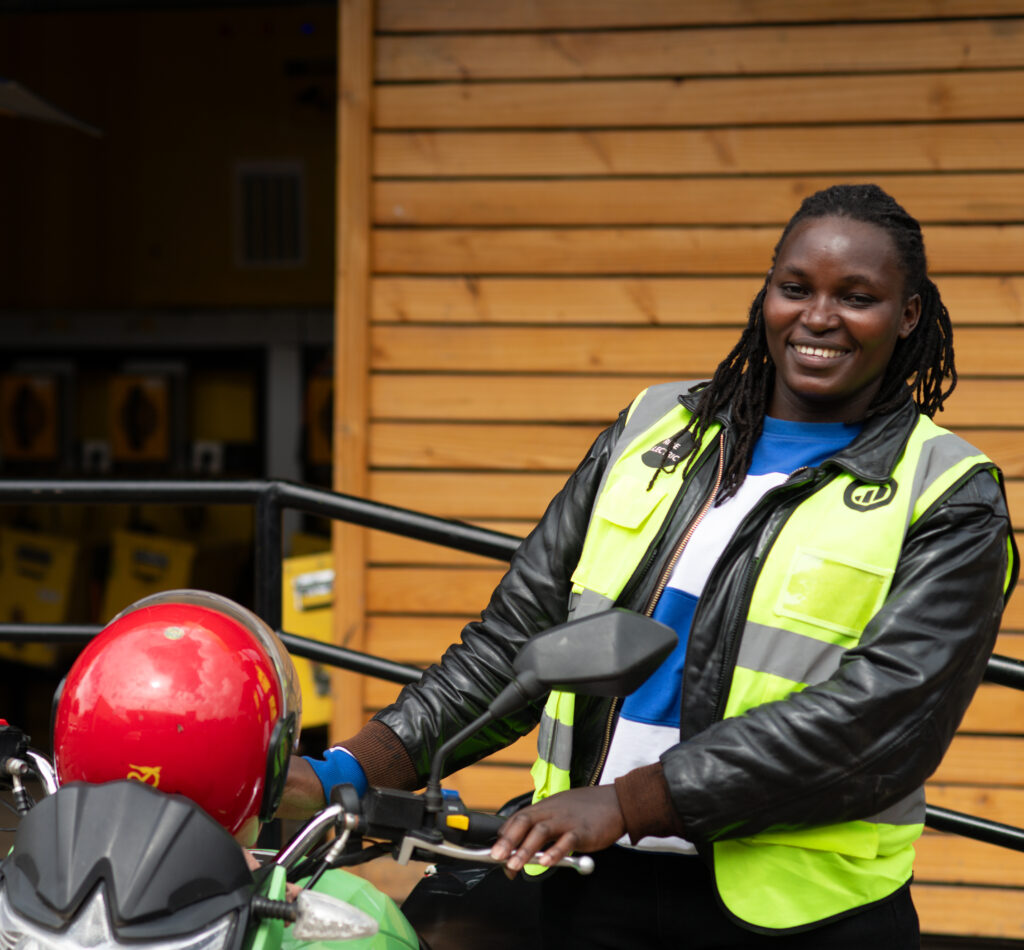
Building the conditions for capital in Africa’s electric two- and three-wheeler market
A year ago, Shell Foundation brought investors together in London to discuss the “missing middle” holding back Africa’s electric two- and three-wheeler sector. On 14 October 2026, we convened a second closed-door roundtable, again moderated by Hystra, with a dozen investors spanning private equity, venture capital, debt, development finance and securitisation, alongside the ASEM consortium (Accelerating Sustainable Electric Mobility in Africa, by Hystra, The Carbon Trust and MobilityX Africa).
A market moving faster than expected
Deployment is ahead of what we projected: our earlier estimate of 500,000 electric two-wheelers in Sub-Saharan Africa by 2032 now looks conservative. Ride-hailing and delivery platforms are pushing the transition to manage their own fuel costs, and Asian manufacturers are entering African markets. For drivers, the case is concrete: our interventions have been associated with average income gains of 20 to 40%.
Capital has not kept pace
Infrastructure remains fragmented, financing is poorly matched to asset-heavy businesses, and late-stage investors told us they need two things before committing: a funded plan to scale, and a visible exit. Consumer finance remains more expensive for electric vehicles than for petrol ones, and battery and infrastructure finance is scarce.
Specialisation and partnerships
Participants questioned whether a single venture-backed operator can carry vehicles, energy, after-sales and consumer finance at once. It is too early to say which models will prevail. Experience so far points to a smoother path for companies that keep the customer relationship and the data, and partner for the rest: site hosts for charging and swapping, specialists for after-sales, contract manufacturers for vehicles. Concessional capital could help de-risk these partnerships, for instance by co-financing market trials with manufacturers.
Data as common ground
Of the opportunities discussed, data sharing and sector insights drew the strongest alignment. Operators have signalled their willingness to share anonymised data on a neutral platform, and investors were clear about what would change their decisions: benchmarks on battery life and asset utilisation, common default definitions and customer satisfaction. Better data also underpins the other priorities raised in the room, from backup servicing to securitisation, which participants considered feasible now provided battery health metrics are standardised.
Mobilising local lenders remains harder. Guarantees and concessional lines have not yet translated into lending, and FX risk and personal guarantees still weigh on founders.
Interoperability
Participants were candid about the technical complexity of interoperability, as operators differ on battery chemistry, voltage and payment systems. Open networks are not always interoperable, and progress does not depend on agreeing a single definition. The question is what level of interoperability, convertibility or backup arrangement is enough to reduce stranded-asset risk. Interoperability could protect riders and investors when an operator fails, and help make customer receivables bankable for third-party financiers. We will continue to explore where we can add value.
Looking ahead
We are keen to keep the conversation going. If you are seeing promising opportunities, have relevant market insights to share, or would like to explore co-investment and co-funding opportunities, we would welcome the opportunity to connect.
Latest news and updates
If Food Is So Expensive, Why Aren’t Farmers Rich?
01st October 2026